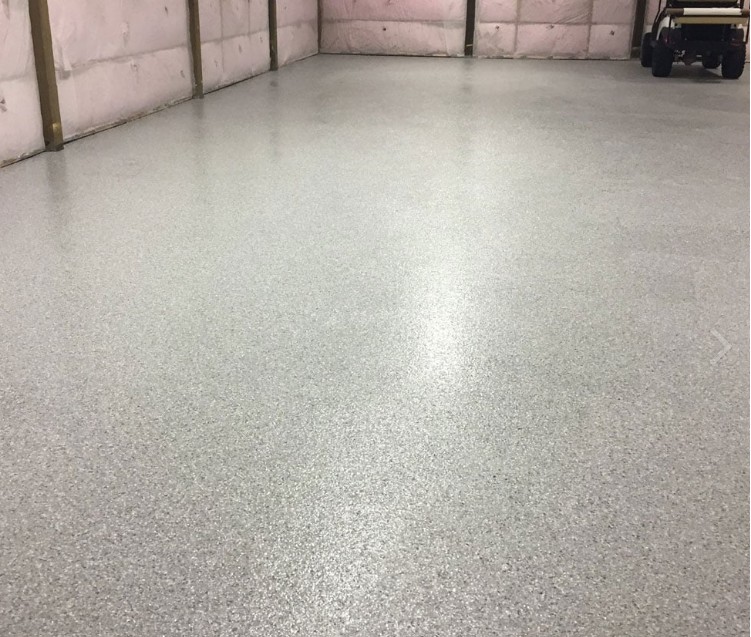
If you're researching epoxy garage floor installation in Myrtle Beach or anywhere in Horry County, you've probably seen pricing that ranges from $800 to $8,000 for what sounds like the same job. That range is real — and the difference between the low end and the high end isn't profit margin. It's materials, prep, and whether the floor will still look good in five years or need complete replacement in three.
This guide covers what epoxy garage floors actually cost in Myrtle Beach in 2026, what drives price variation, why coastal South Carolina's environment requires specific product selection, and what questions to ask any contractor before signing anything.
Here is what you should expect to pay for a professionally installed, commercial-grade epoxy system in Myrtle Beach and Horry County in 2026. These prices are all-inclusive — labor, prep, base coat, color flake broadcast, and polyaspartic topcoat.
| Garage Size | Approximate Sq Ft | All-Inclusive Price |
|---|---|---|
| 1-Car Garage | 200–280 sq ft | $1,800 |
| 2-Car Garage | 400–500 sq ft | $3,000 |
| 3-Car Garage | 650–900 sq ft | $4,500 |
| Large / Custom | 900+ sq ft | Free on-site quote |
| Pool deck / patio | Varies | Free on-site quote |
Diamond-grind surface prep, crack and joint repair, moisture barrier primer, 100% solids epoxy base coat, full-broadcast color flake system, and polyaspartic UV-stable topcoat. No hidden costs. Price confirmed before any work begins.
If you've gotten quotes from national franchise epoxy companies or looked at DIY pricing from big-box stores, you've probably seen numbers significantly lower than what professional installers quote in coastal South Carolina. There are three reasons for this gap — and they all come back to what the coastal environment does to epoxy systems that aren't specified for it.
Myrtle Beach's water table is shallow and the relative humidity is consistently high. Concrete slabs in coastal SC transmit significantly more moisture vapor than inland slabs, especially in the warmer months. When epoxy is applied over concrete with elevated moisture vapor transmission without a moisture barrier primer, the moisture drives up from underneath and causes the coating to blister and delaminate — sometimes within the first six months. This is the most common reason DIY epoxy kits and cheap installations fail in coastal markets.
Professional-grade systems for Myrtle Beach use a moisture-tolerant primer coat specifically engineered for high-humidity environments. This adds material cost compared to standard inland systems but eliminates the delamination failure mode that makes budget installs a false economy.
The biggest product quality split in the epoxy market is between water-based systems (which dominate DIY and budget contractor installations) and 100% solids systems (which professional commercial installers use). Water-based systems are 40–60% water by volume — what's left after the water evaporates is a thin film coating. 100% solids systems cure completely without off-gassing or water evaporation, producing a thicker, denser, harder final film.
For a Myrtle Beach garage that sees beach sand, salt, and vehicle traffic, the difference is visible within 18–24 months. Water-based systems show wear, micro-scratches from sand, and UV degradation. 100% solids systems maintain their appearance for 15–25 years with normal maintenance.
Surface preparation is the single most important factor in epoxy adhesion and longevity. There are two methods: acid etching and diamond grinding. Acid etching is cheap, fast, and inadequate for any serious installation — it opens concrete pores slightly but doesn't create the mechanical tooth that epoxy needs to truly bond. Diamond grinding uses rotating abrasive heads that remove the top layer of concrete and create a consistent surface profile that produces mechanical adhesion rather than just chemical adhesion. It's slower, requires more equipment, and costs more — and it's the only method that produces installations that last.
"Do you diamond grind or acid etch?" If the answer is acid etch, or if they don't know what diamond grinding is, keep looking.
Bakerss offers 50+ color options across four product lines. Color selection is done during the free on-site consultation with physical samples shown against your garage's existing finishes and lighting.
The most popular category. Neutral blends of tan, brown, grey, and cream that complement most home exterior color palettes. These are the colors that photograph well for vacation rental listings and show the least visible dirt between cleanings — a practical consideration for busy Grand Strand properties.
Myrtle Beach area teams represented — Coastal Carolina Chanticleers teal and gold, South Carolina Gamecocks garnet and black, Clemson Tigers orange and purple. These are popular in man cave builds and properties owned by serious fans.
Larger format flakes that create a stone-like appearance. More dramatic visual impact than standard chip systems. Popular in higher-end homes where the garage is part of the overall interior design aesthetic.
Metallic pigment systems that create a three-dimensional flowing appearance — like frozen liquid metal on the floor. The highest-end aesthetic option. Popular in luxury builds and properties where the garage serves as a showroom for vehicles or equipment.
A professional epoxy garage floor installation in Myrtle Beach takes two days. Here is exactly what happens on each day.
This is the most important day. The garage is cleared completely (you need to remove everything before the crew arrives). Diamond grinders profile the entire concrete surface, removing paint, sealers, adhesive residue, and the weak surface layer of the concrete itself. Cracks are filled and feathered with appropriate repair compounds. Expansion joints are treated. The moisture vapor transmission rate is tested. If the slab shows elevated moisture, the moisture barrier primer is specified and applied as the first coat, then allowed to cure before the next step. The crew leaves with a properly prepared slab, ready for coating the following morning.
The 100% solids epoxy base coat is applied to the prepared slab. While it is still wet and tacky, the color flake chips are broadcast across the surface — either at a partial broadcast for coverage with the base color showing through, or at a full broadcast for complete flake coverage. After the base cures, excess chips are scraped and vacuumed. The polyaspartic topcoat is applied in two coats, encapsulating the chips completely and providing the UV-stable, chemical-resistant wear surface. The crew leaves. The floor needs 24 hours before light foot traffic and 72 hours before vehicles.
Big-box store epoxy kits cost $100–$300 and are marketed as weekend projects. They are water-based systems applied without diamond grinding onto unprepared concrete. In Myrtle Beach's coastal environment, with its moisture vapor transmission and beach sand traffic, most DIY epoxy kit installations show visible wear, peeling, and hot-tire pickup failure within 12–18 months. The cost to strip a failed DIY installation and apply a professional system afterward is higher than simply having the professional system installed from the start.
For a vacation rental or investment property where the garage floor is a guest-facing amenity that affects listing photos and review scores, a failed DIY floor is not just a maintenance expense — it's a revenue impact.
Ray Cloyd walks every property before quoting any epoxy floor installation. We assess the concrete condition, moisture levels, crack locations, and specific product requirements for your garage before committing to any price. No obligation. Free estimate confirms everything before work begins.
Schedule a Free Estimate → 📞 843-467-7136A properly installed 100% solids epoxy system with polyaspartic topcoat lasts 15–25 years in Myrtle Beach's coastal environment when maintained correctly. "Maintained correctly" means sweeping regularly to remove beach sand (the primary wear agent), cleaning chemical spills promptly, and avoiding dragging metal furniture or sharp objects across the surface.
The polyaspartic topcoat is the key to longevity in a coastal market. Standard epoxy topcoats yellow under UV exposure — a significant issue in South Carolina's high-UV-index environment. Polyaspartic formulas are UV-stable, maintaining their appearance and clarity in direct sunlight without yellowing, chalking, or degrading. This is why professional coastal installers specify polyaspartic rather than standard epoxy or urethane topcoats.
Starting at $1,800 for a 1-car garage, $3,000 for a 2-car garage, and $4,500 for a 3-car garage. These are all-inclusive prices — prep, base coat, color flakes, and polyaspartic topcoat. Larger or custom garages are quoted after a free on-site consultation.
Two days for most Myrtle Beach residential garages. Day 1 is surface preparation (diamond grinding, crack repair, moisture testing). Day 2 is the epoxy system application. 24-hour cure before foot traffic, 72 hours before vehicles.
Yes — and it's the most important consideration for any Myrtle Beach epoxy installation. Coastal concrete has higher moisture vapor transmission than inland slabs. Systems without moisture barrier primers delaminate in 6–18 months. Professional coastal installers specify moisture-tolerant primer systems and 100% solids coatings that perform in high-humidity environments.
15–25 years for a properly installed 100% solids system with polyaspartic topcoat. The polyaspartic topcoat is UV-stable, which prevents the yellowing and degradation that standard epoxy topcoats develop under South Carolina's high UV index.
50+ options across four lines — Earth Inspired flake chips (neutral blends), Team Inspired flake chips (CCU, Gamecocks, Clemson), Marble Flakes (stone appearance), and 3D Effects Metallic Powder (high-end metallic finish). Physical samples shown at the free on-site consultation before any commitment.
Yes. Pool deck epoxy requires a slip-resistant additive in the topcoat (required for any pool surround), UV-stable formulas for constant direct sun exposure, and specific surface prep for the concrete types and conditions pool decks develop over time. Free on-site estimates for pool deck applications.