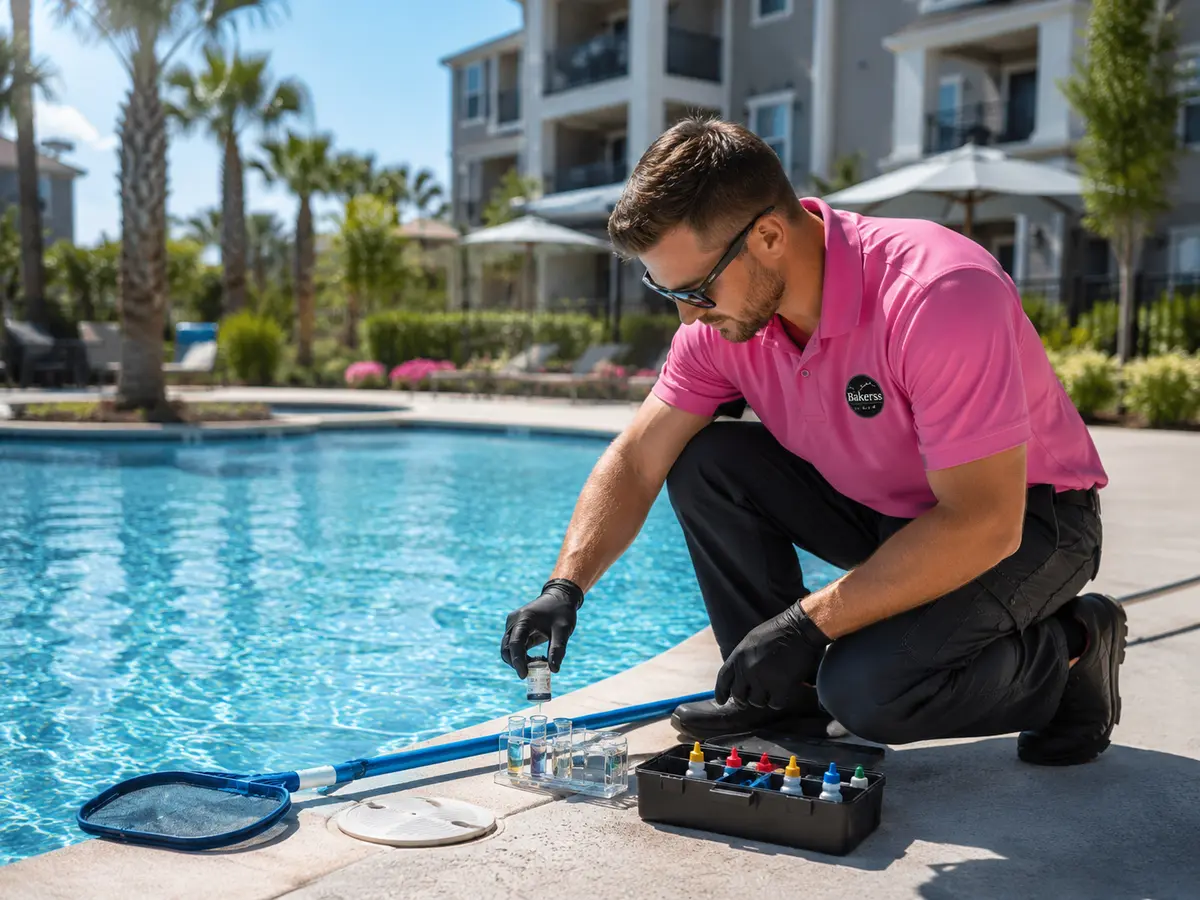
Pool chemistry in Myrtle Beach is more demanding than in almost any other residential market in the country. The combination of summer temperatures regularly exceeding 90°F, UV indices among the highest in the continental United States, high bather loads from vacation rental guests, and the coastal humidity that keeps organic matter suspended in outdoor air all create conditions where pool water can shift from safe and clear to unsafe and cloudy within 24–48 hours during peak summer. Understanding the chemistry is the foundation of keeping a Myrtle Beach pool safe, clear, and usable through the entire season.
Free chlorine is the active sanitizer in your pool — the chlorine available to kill bacteria, algae, and organic contaminants. Target range: 2–4 ppm for standard residential pools; 3–5 ppm for vacation rental pools with high bather loads. In Myrtle Beach's summer conditions, free chlorine degrades much faster than in cooler or less UV-intense markets. A pool tested at 3 ppm free chlorine in the morning may read 0.5 ppm by afternoon on a hot sunny day without stabilizer protection.
Combined chlorine is what happens to free chlorine after it reacts with nitrogen-containing compounds — sweat, sunscreen, urine, and organic debris introduced by bathers. Combined chlorine produces chloramines — the compound responsible for the strong "pool smell" and eye irritation that most people associate with "too much chlorine." Paradoxically, that smell indicates chlorine is doing its job but getting used up. Target: CC below 0.2 ppm. When CC is above 0.5 ppm, the pool needs breakpoint chlorination — a large shock dose that burns off the combined chlorine.
pH is the measure of acidity/alkalinity. Target range: 7.4–7.6 for residential pools. pH above 7.8 makes chlorine significantly less effective — at pH 8.0, chlorine is only about 20% as effective as at pH 7.4. pH below 7.2 causes eye and skin irritation and can damage pool surfaces and equipment. Myrtle Beach pools tend to drift upward in pH from evaporation and rain refill — most require pH decreaser (muriatic acid or sodium bisulfate) more often than increaser.
Total alkalinity is the buffer that keeps pH stable. Target: 80–120 ppm. Low alkalinity causes pH to swing wildly — a condition called "pH bounce." High alkalinity causes pH to be stubbornly high and difficult to lower. Alkalinity adjustments must be made before attempting to stabilize pH — you can't hold pH stable without proper alkalinity backing it up.
This is the parameter that most distinguishes Myrtle Beach pool chemistry from northern or indoor pool management. Cyanuric acid is a UV stabilizer that protects free chlorine from solar degradation. Without stabilizer, chlorine in direct Myrtle Beach summer sun can degrade completely within 2–4 hours. Target CYA: 30–50 ppm for outdoor residential pools; 40–60 ppm for outdoor STR pools. Above 80 ppm, CYA becomes counter-productive — it binds chlorine so effectively that the chlorine becomes less available for sanitization (the "chlorine lock" problem).
Target: 200–400 ppm for plaster/concrete pools. Low calcium causes water to aggressively leach calcium from pool surfaces — plaster pitting and surface etching follow. High calcium causes scaling on pool surfaces and equipment. Myrtle Beach's coastal water supply tends toward moderate hardness; calcium is typically not the most frequent adjustment pool owners need to make.
| Factor | Effect on Chemistry | Result |
|---|---|---|
| 90°F+ summer water temps | Accelerates algae growth, increases chlorine demand | Higher chlorine maintenance doses required |
| High UV index | Degrades unstabilized chlorine in 2–4 hrs | CYA stabilizer is essential, not optional |
| STR high bather loads | Introduces nitrogen compounds → chloramines | More frequent shock treatments needed |
| Coastal humidity + rain | Dilutes pool chemistry, introduces organics | More frequent testing and adjustment |
Test free chlorine, combined chlorine, pH, and total alkalinity weekly minimum. During STR peak season (June–August), twice-weekly testing is the professional standard.
Correct pH before addressing chlorine. Chlorine effectiveness depends on pH — correcting chlorine without correcting pH is wasted product.
Maintain free chlorine at 2–4 ppm (residential) or 3–5 ppm (STR). Use slow-release trichlor tablets for baseline maintenance; cal-hypo or liquid chlorine for shock doses.
Brushing removes algae from surfaces before it can establish a biofilm. Even with adequate chlorine, unmoved algae on surfaces can establish and resist chemical treatment.
Remove surface debris and bottom debris to reduce organic load that drives chlorine demand.
Visual inspection of pump, filter pressure, automation system, and visible plumbing each visit.
Weekly chemistry testing · All chemicals included · STR calendar sync · From $150/month · 843-467-7136
Get a Free Estimate →📞 843-467-7136Paradoxically, the 'chlorine smell' is actually combined chlorine (chloramines) — what happens to chlorine after it's reacted with nitrogen compounds from bathers. It means your pool needs more free chlorine, not less. A breakpoint shock treatment burns off the combined chlorine and restores the free chlorine residual.
Weekly for standard residential pools. Twice weekly for vacation rental pools with high bather loads during peak season (June–August). After any significant rainfall, test and adjust — rain dilutes chemistry and introduces organics.
30–50 ppm for standard outdoor residential pools. 40–60 ppm for outdoor STR pools with high bather loads. Do not exceed 80 ppm — above that threshold, CYA binds chlorine so effectively that the pool becomes difficult to sanitize properly despite apparently adequate chlorine readings.
Algae growth is directly driven by water temperature and the balance between algae growth rate and chlorine sanitization capacity. At 88–92°F water temperature in July, algae can begin visibly establishing within 24–48 hours if free chlorine drops below 1 ppm. High bather loads in vacation rentals accelerate chlorine consumption. The solution is consistent weekly professional maintenance rather than reactive treatment after green water appears.